

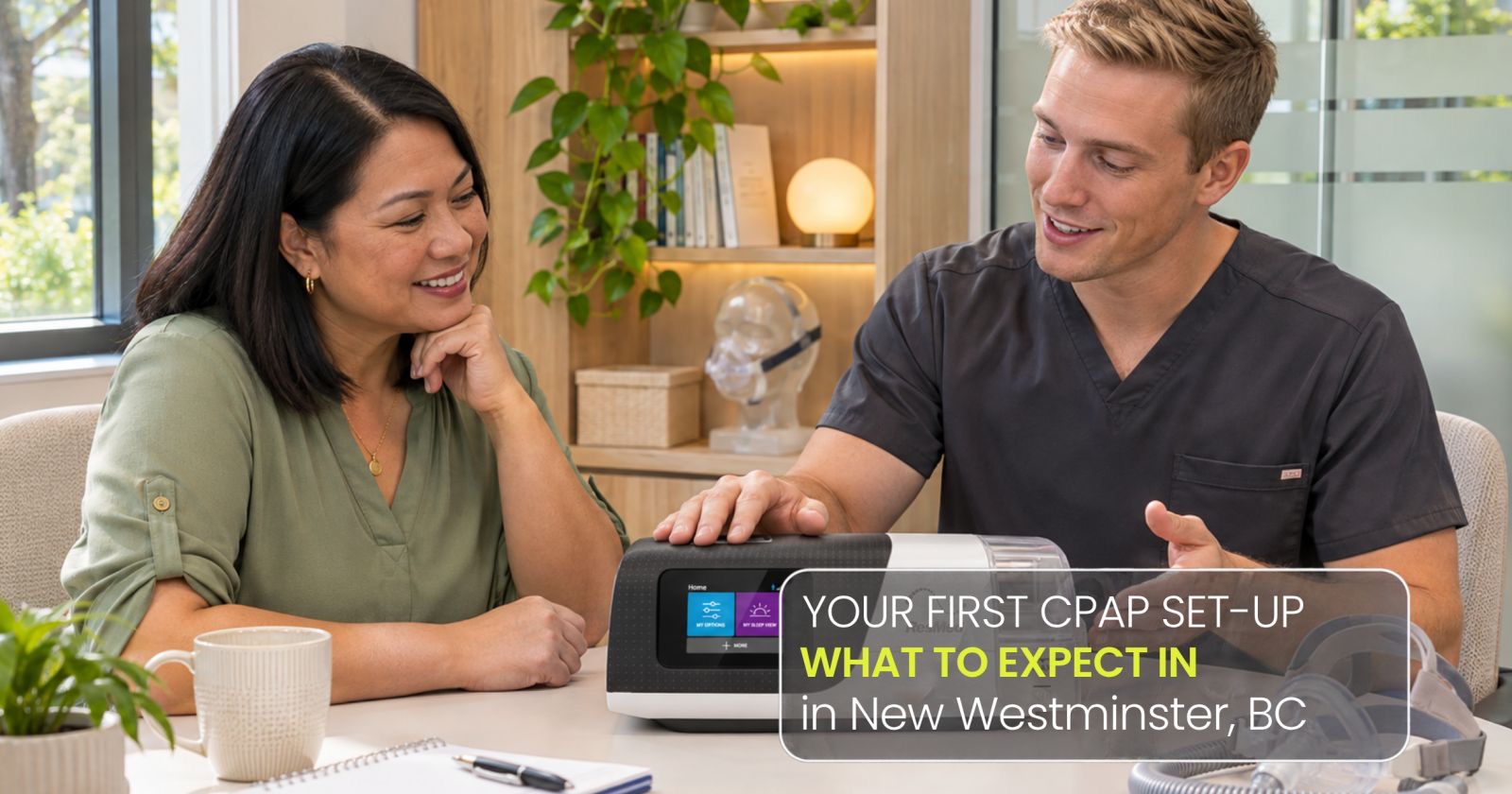
If your doctor has prescribed CPAP therapy for obstructive sleep apnea, your first setup appointment is where you learn how to use the equipment before your first night at home. At CPAP Pros in New Westminster, the initial appointment usually takes about an hour and covers your sleep study findings, your prescribed therapy, mask fitting, and how to use and care for your machine. It’s also a chance to ask what to do if the mask leaks or the airflow feels unfamiliar at bedtime.
Once CPAP Pros receives your signed prescription, the team can arrange your setup appointment. When booking, ask whether they already have your prescription and sleep study report. If either document is still needed, the team can tell you how to provide it. If you already own a CPAP machine or mask, mention it when booking and ask whether to bring it or have it beside you for a virtual appointment. It helps to write down any concerns you want to discuss, such as nasal congestion, sleeping on your side, or feeling uncomfortable with a mask over your face.
CPAP Pros offers virtual appointments with its coaches through platforms such as Zoom or FaceTime and can ship equipment to your home. If you prefer to meet in person, ask about setup availability at the New Westminster office when you book. For a virtual appointment, have your machine, power cord, tubing, and mask within reach if they’ve already arrived, and set up near a power outlet so you can follow along during the demonstration.
The appointment begins with a review of your sleep study findings and your doctor’s prescription. Your clinician can explain what the study showed, why your doctor recommended therapy, and how the prescribed treatment guides machine selection and setup. CPAP delivers a steady flow of pressurized air through a mask to help keep your airway open while you sleep. If the pressure feels uncomfortable once you start using the machine, contact the clinic for help with your prescribed settings.
Mask fitting is a key part of the setup. A facial scanning tool can help guide the choice of style and size, and the fitting gives you a chance to see how the mask feels. Depending on your needs, options may include a nasal mask that covers your nose, nasal pillows that sit at the nostrils, or a full-face mask that seals around your nose and mouth. Tell your clinician if you often breathe through your mouth at night, have trouble breathing through your nose, or tend to sleep on your side. Those details can help guide which mask you try. With the airflow on, check for air blowing toward your eyes, gaps around the cushion, or straps that feel too tight.
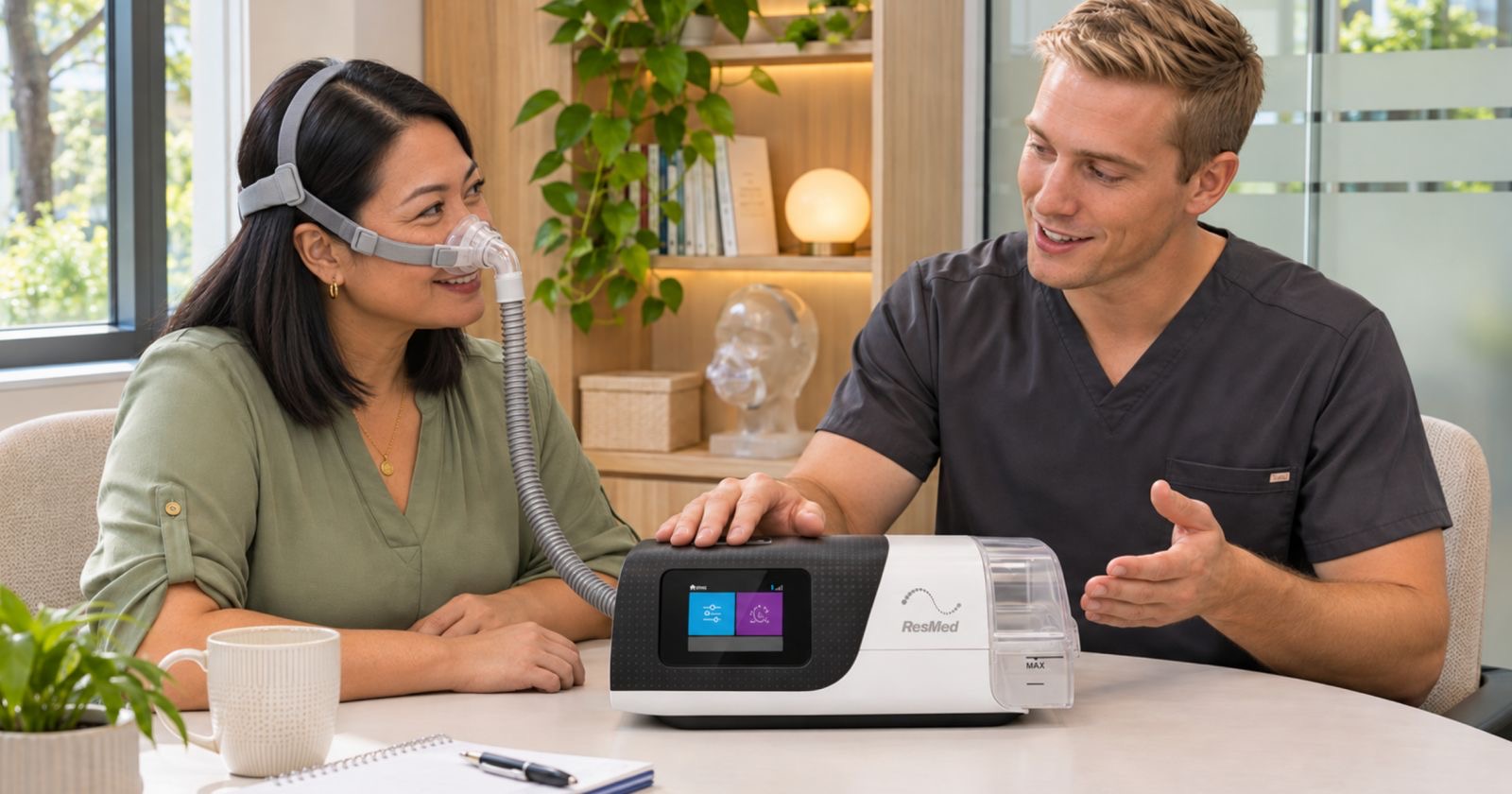
Your clinician walks you through how to connect the tubing, put on and remove the mask, and start and stop the machine. If your model has a humidifier, the demonstration can cover how to fill the chamber, what type of water your model calls for, and how to use its humidity controls. You can also learn how the ramp feature works if your machine has one. Ramp starts the airflow at a lower pressure and gradually increases it as you settle in.
Use the demonstration to practise the steps yourself. Connect the mask and tubing, put the mask on, turn the machine on, and take a few breaths with the airflow running. If you feel a leak or a pressure point, show the clinician where it is so they can help you adjust the fit. It’s also worth practising how to disconnect and reconnect the tubing if you usually get up during the night.
Before you finish, go over which parts need cleaning, how often to clean them, and when to check or replace the filter. CPAP Pros’ general guidance recommends cleaning the mask daily and the tubing and humidifier chamber at least weekly. Follow the instructions for your specific model and mask, since some cushions and filters require different care. For washable parts, check which cleaning products the manufacturer recommends and let the parts air-dry before reassembling them.
At home, keep your machine and mask manuals handy. CPAP Pros also has an Instructional Videos page with guides for selected machines and masks, including videos on setup, cleaning, and filter replacement. If you forget how to take a part apart or reconnect it, look for the video or manual that matches your model.
During the first few nights, you may notice a dry nose or mouth, air leaking around the mask, or discomfort as you get used to the airflow. Some people find it helpful to wear the mask with the machine running for a short time while awake, such as while reading or watching TV. If you keep waking up because of leaks, dryness, or discomfort, contact the team. Describe what you felt and when it happened. For example, a mask that leaks only when you turn onto your side gives your coach a specific fit issue to look at with you.
CPAP Pros typically checks in after the first week, the second week, and around 30 days. Further follow-ups are generally scheduled at three months, six months, and one year, then every six months. Confirm at your setup appointment how the team will contact you. At your first check-in, share how often you’ve been able to use the machine, whether the mask stays comfortable through the night, and any issues that are making it hard to keep using therapy.
If you need help before your next check-in, call CPAP Pros at 604-229-1630 or email info@cpappros.ca and ask to speak with a Sleep Coach. You can also use the contact form on the CPAP Pros website. If you already have a prescription and are ready to book, contact the New Westminster team to confirm what records they have and which appointment options are available.
Recent Comments